“The world was never ours to rule. It was ours to keep.” So reads an inscription preserved beneath the oldest foundations of Solrhain. No scholar knows who carved it. The stone upon which the words appear predates the city itself.
Tharyndor
Tharyndor is a world of old kingdoms and older scars.
Across its seas stand civilizations that measure their histories in centuries, while beneath their roads lie the foundations of peoples whose names have vanished entirely. Mountains bear doors no living mason remembers carving. Forests grow around pillars without inscriptions. Ruined roads disappear beneath lakes and emerge again hundreds of miles away.
Even the oldest peoples of Tharyndor live among remnants of something older.
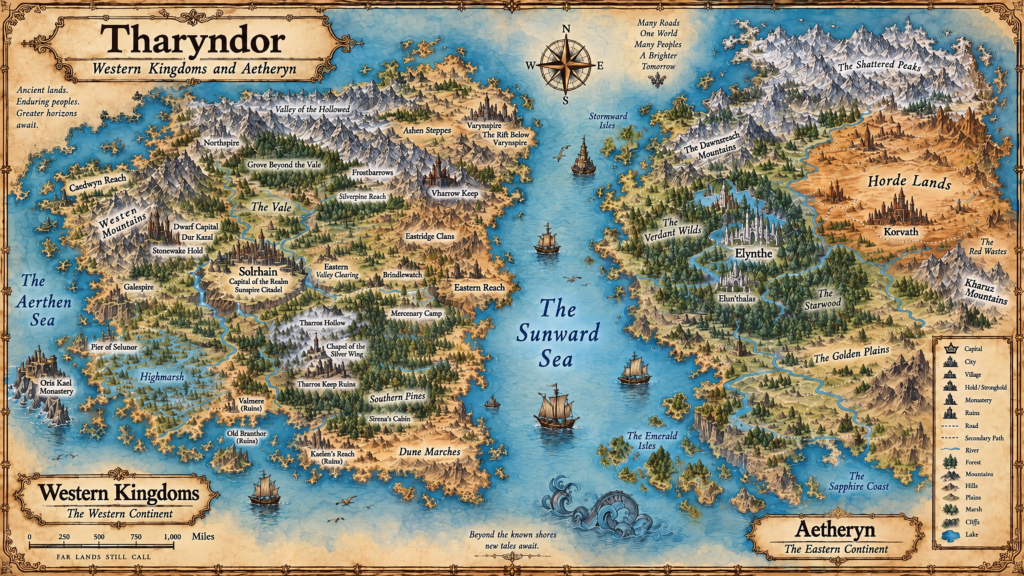
Today, most maps divide the known world between two great continental realms.
To the west lie the Western Kingdoms, home to the human realms, the ancient dwarven holds, the radiant capital of Solrhain, and the northern wilderness beyond the Vale.
Across the Sunward Sea lies Aetheryn, land of the elven kingdoms, the ancient forests of Elynthe, the Horde territories surrounding Korvath, and civilizations whose histories rarely appear in western chronicles.
These lands are separated by oceans, mountains, languages, faiths, and old grievances.
They were not always so divided.
Long before crowns were forged and borders drawn, the peoples of Tharyndor understood the world very differently.
That age is remembered only in fragments.
The First Light
The oldest surviving elven records call the earliest known age the First Light.
No reliable account survives from its beginning.
What remains comes from songs preserved in Aetheryn, stone tablets recovered from forgotten dwarven chambers, fragments kept beneath Solrhain, and ruins whose construction cannot be attributed to any living civilization.
The peoples of the First Light did not understand magic as modern scholars do.
There were no formal schools of arcane practice. No division between elemental, spiritual, celestial, or natural forces.
Magic was believed to exist within the structure of creation itself.
Stone carried memory.
Water carried change.
Storms carried motion.
Living things carried will.
Time carried consequence.
These forces were not worshiped as gods, nor were they regarded as tools. They were understood as parts of a greater order whose laws the earliest civilizations learned to observe.
Their greatest cities were therefore not always built where rivers met or armies could defend them.
Some were constructed where the world itself seemed unusually awake.
Varynspire was one such place.
The Valley of the Hollowed was another.
Others remain buried beneath the forests and mountains of Aetheryn.
And beneath several of these sites, the First Peoples discovered something that would alter Tharyndor forever.
The Boundaries
The world was not alone.
Beyond Tharyndor existed other places.
Whether they were worlds, planes, dimensions, or something for which mortal language has no adequate word remains disputed among scholars.
The oldest writings call the divisions between them simply the Boundaries.
Modern depictions often portray these Boundaries as walls separating one realm from another.
The ancient texts describe something stranger.
They call them agreements.
The world existed because certain things remained apart.
Life and whatever lay beyond it could approach one another but were not meant to occupy the same space.
The sky did not fall into the sea.
Memory did not become matter.
The living did not walk freely among whatever waited beyond the dark.
The Boundaries preserved these distinctions.
For an unknown span of time, that order held.
Then someone attempted to cross it.
The First Rift
The oldest known rupture occurred in the northern highlands, in the place now called the Valley of the Hollowed.
Who opened it has been forgotten.
Some traditions claim the First Peoples sought knowledge.
Others speak of a war.
A few surviving fragments suggest they were trying to prevent something from reaching Tharyndor.
No account has ever been proven.
What is known is that the Boundary opened.
Something existed on the other side.
And for the first time, it looked back.
The resulting catastrophe transformed the northern highlands.
Mountains fractured.
Rivers changed course.
Entire settlements vanished from historical record.
What occurred inside the Valley became so feared that later generations deliberately destroyed the roads leading toward it.
Ancient elven songs speak of three entrances through the surrounding mountains.
Two were collapsed before the first human kingdoms arose.
One remained.
The wound eventually closed.
But it never truly healed.
From that age onward, the world became vulnerable to fractures.
The Sundering
The First Rift broke more than the Boundary.
It broke the civilization that had once connected the peoples of Tharyndor.
Survivors scattered.
The ancestors of the elves journeyed east across the lands that would become Aetheryn.
Dwarven peoples withdrew deeper into their mountain cities.
Human settlements spread across the fertile valleys of the western continent.
Other peoples migrated beyond the regions recorded by early human cartographers.
Knowledge once shared among civilizations became guarded.
Stories became traditions.
Traditions became legends.
Legends became superstition.
And the memory of what had happened in the Valley slowly faded.
Historians later named the centuries that followed the Sundering of the Peoples.
From its aftermath emerged the world known today.
The Age of Crowns
Human civilization expanded rapidly across the western continent.
Settlements became cities.
Cities became kingdoms.
Kingdoms became rivals.
Roads were built across lands that had once been wilderness, and fortresses rose along borders that previous generations had never recognized.
From among these growing powers emerged Solrhain.
Built upon the radiant plateau, Solrhain commanded the surrounding valleys and the great roads running through the heart of the Western Kingdoms.
Its position made it defensible.
Its rivers made it prosperous.
Its location made it unavoidable.
What began as a fortified settlement eventually became the greatest human city in the west.
At its heart rose the Sunspire Citadel.
And above the city flew the banner of House Valebright.
House Valebright
The Valebright kings claim no divine right to rule.
Their oldest traditions tell a different story.
During an age of famine and invasion, several rival settlements surrounding the radiant plateau faced destruction. According to royal chronicles, the first ruler of House Valebright did not conquer them.
He persuaded them to stand together.
The crown that followed was therefore intended to represent responsibility rather than dominion.
A ruler did not possess the kingdom.
A ruler kept it.
This distinction became central to the earliest Valebright philosophy.
Over generations, however, principles became ceremonies.
Ceremonies became institutions.
Institutions became traditions defended simply because they were traditions.
By the reign of King Alaric Valebright, Solrhain remained the strongest human capital in the Western Kingdoms.
But the kingdom surrounding it had grown cautious.
Councils debated while border settlements disappeared.
Lords protected authority rather than responsibility.
Old institutions became reluctant to acknowledge threats they could not control.
Into this world was born Merrik Caelum Valebright.
A prince raised to inherit a crown whose meaning had become far less certain than its power.
The Dwarven Realms
West and northwest of Solrhain rise the great mountain territories of the dwarves.
Few human kingdoms can accurately trace their histories as far into the past.
Dwarves can.
Their oldest cities were carved before many human languages existed in their present form.
Among the mountain roads stand Dur Kazal, Stonewake Hold, and the greater dwarven capital beyond them.
To outsiders, dwarven fortresses appear built primarily for defense.
They are not.
They are built for remembrance.
Dwarven culture teaches that creation carries obligation.
A blade records the hand that forged it.
A wall records those who stood behind it.
A name spoken in oath becomes part of the memory of those who hear it.
Stone remembers.
Craft remembers.
Oaths remember.
For this reason, the destruction of history is regarded among many dwarven communities as a crime nearly equal to murder.
Their halls are therefore fortresses, homes, temples, and archives at once.
The tradition of the Lionsguard, to which Tytos Thorneye belongs, emerged from this philosophy.
Strength exists not to dominate those weaker than oneself.
Strength exists to stand where others cannot.
Across the Sunward Sea
East of the Western Kingdoms, beyond the waters of the Sunward Sea, lies Aetheryn.
Western maps once described it simply as the land of the elves.
It never was.
Aetheryn contains cultures older than several western kingdoms combined, and its history cannot be reduced to a single people.
Its forests conceal ancient roads.
Its mountains divide civilizations.
Its plains have carried armies, caravans, migrations, and entire nations.
Two of its greatest powers grew from very different traditions.
The elven realms of Elynthe.
And the confederation centered upon Korvath.
Elynthe
The forests surrounding Elynthe are among the oldest inhabited regions in the known world.
The elves who settled Aetheryn after the Sundering did not tame these forests.
They learned to inhabit them.
Their cities grew around rivers rather than redirecting them.
Structures were raised beside ancient trees rather than clearing them.
Some towers were shaped over generations from living wood and stone.
Others stand upon foundations whose builders remain unknown.
At the heart of these lands lies Elynthe, one of the oldest continuously inhabited cities in Tharyndor.
Its towers rise between waterways and immense forests where sunlight sometimes fails to reach the earth.
To outsiders, Elynthe appears timeless.
The elves know better.
Nothing is timeless.
Not even memory.
South of Elynthe stands Elun’thalas.
Its oldest foundations predate the city that now surrounds them.
Entire districts lie silent beneath root and stone, preserved rather than rebuilt.
No complete record explains who first constructed them.
The elves simply call them the Elder Foundations.
Some doors within Elun’thalas have never been opened.
Others were opened once.
And sealed again.
The Horde
East of the forests of Elynthe stretch the plains, badlands, and harsh interior territories collectively known as the Horde Lands.
The Horde is not a single race.
Nor did it begin as an empire.
It began as an agreement.
For centuries, the Orcs, Trolls, and Ruunari of eastern Aetheryn lived as separate peoples.
The Orc clans occupied the red plains and mountain approaches, where survival demanded discipline, strength, and fierce loyalty to kin. The Troll tribes lived throughout river valleys, jungles, highlands, and ancient ruins, preserving traditions older than many outsiders realize. The Ruunari wandered the great grasslands beneath enormous skies, following seasonal migrations and sacred paths known only to their clans.
Each people possessed its own leaders.
Its own traditions.
Its own wars.
And for generations, its own enemies.
Then came a threat none could survive alone.
The exact nature of that ancient enemy remains disputed, but the result is remembered throughout eastern Aetheryn.
The clans gathered beneath one banner. Orcs stood beside trolls. Trolls stood beside Ruunari. Old blood debts were suspended. Rival chiefs entered the same fortress.
That gathering place became Korvath.
And the alliance forged there became the Horde.
The Ruunari
Among the founding peoples of the Horde, none are more closely tied to the open lands than the Ruunari.
Tall and powerfully built, with broad horns and features resembling the great horned beasts of Aetheryn’s plains, the Ruunari lived for generations as migratory clans.
Their oldest traditions teach that land cannot truly belong to a person.
A people may defend it.
Care for it.
Be buried within it.
But ownership ends with death.
The land remains.
This belief frequently placed them at odds with expanding kingdoms whose maps converted migration routes into borders.
Ruunari history is preserved primarily through spoken lineage, carved horn, woven banners, and enormous standing stones raised along ancestral routes.
Many of those routes now converge upon Korvath.
Yet even today, some Ruunari clans refuse permanent residence within the capital.
They belong to the road between places.
Korvath
Korvath was never intended to become a city.
The original fortress stood near the meeting point of several ancient clan territories.
Whenever war threatened eastern Aetheryn, representatives gathered there under temporary truce.
Weapons remained at the gates.
Blood feuds remained outside the walls.
Inside, enemies spoke.
When the alliance that became the Horde endured beyond the war that created it, the gathering fortress changed.
Markets appeared outside its walls.
Smiths arrived.
Families remained between councils.
Roads converged.
New walls were constructed around the old ones.
The fortress became a settlement.
The settlement became a city.
The city became the capital of the Horde.
Korvath remains unlike Solrhain.
Solrhain grew around a dynasty.
Korvath grew around an agreement.
Its leaders rule only so long as the peoples of the Horde continue to accept the bonds holding them together.
That makes the Horde appear unstable to western observers.
The Horde considers it the source of its strength.
Elynthe and Korvath
The histories of Elynthe and Korvath are not histories of endless war.
Nor are they histories of peace.
Their borders have known both.
Elven forests control some of the oldest waterways and medicinal lands in Aetheryn.
Horde territories command enormous overland routes, mineral deposits, grazing lands, and passages into the eastern mountains.
Neither civilization exists in isolation.
For centuries they have traded.
Fought.
Negotiated.
Betrayed one another.
Saved one another.
Border towns carry both languages.
Certain markets observe both elven festivals and Horde remembrance days.
Some families can trace ancestors to both sides of wars their descendants barely remember.
The relationship survives because geography makes separation impossible.
History makes trust difficult.
The Age of Fractures
Long after knowledge of the First Rift had faded into legend, strange events began occurring throughout Tharyndor.
At first they seemed unrelated.
Animals refused familiar roads.
Forests became silent.
Streams froze beneath summer sun.
Stone cracked without pressure.
Travelers vanished.
Entire settlements reported hearing voices beneath the earth.
Kingdoms treated each event as a local problem.
Some blamed neighboring rulers.
Others blamed magic.
Several suppressed reports rather than risk panic.
Then the breaches began.
Places where the Boundary weakened enough for something beyond it to touch the world.
One city fell.
Then another.
Valmere.
Old Branthor.
Kaelen’s Reach.
Still the kingdoms debated.
And somewhere beyond their councils, Morvanya was learning.
Every fracture taught her something.
Every breach revealed another law.
Every failure brought her closer to understanding how the ancient Boundary had once been opened.
She did not seek merely to destroy Tharyndor.
She sought to understand how its doors worked.
Varynspire
Long before the Age of Fractures, Varynspire was a place of pilgrimage.
Its heights were associated with the moon, observation, and traditions whose original meanings had already begun to fade.
Pilgrims once gathered there to watch the moon rise above the mountains.
Centuries later, the site became a ruin.
Then the ground beneath it opened.
The Rift Below Varynspire was larger than the breaches that preceded it.
Stone folded.
Trees bent toward the opening.
Thunder rose from beneath the earth rather than the sky.
Those who stood above the breach understood that it was different.
Varynspire was not the destination.
It was a lesson.
The Boundary could still be opened.
And Morvanya now knew how.
The Valley of the Hollowed
Far north of the kingdoms lies the oldest scar in Tharyndor.
The Valley of the Hollowed.
Broken peaks surround it.
Ancient roads vanish before reaching it.
Maps disagree about the paths through the mountains.
Songs remember what histories have forgotten.
At the center of the valley lies the oldest known Boundary.
The wound of the First Rift.
The place where the world once opened.
Morvanya seeks the Valley because the lesser fractures are only echoes of what happened there.
Varynspire proved that the Boundary could be wounded.
The Valley could tear it apart.
And beyond that ancient threshold waits something whose name survived even when almost everything else concerning it was forgotten.
Nheradax.
The Void Master.
It does not seek a kingdom.
It does not seek worship.
It does not seek conquest.
Conquest requires something to remain after victory.
Nheradax seeks something else.
Erasure.
An Old World at the Edge of Something New
For most of recorded history, the peoples of Tharyndor believed their greatest dangers came from one another.
Human against human.
Elf against Horde.
Kingdom against kingdom.
Clan against clan.
Old grievances shaped borders while older truths disappeared beneath them.
Yet beneath every kingdom lies the same earth.
Beyond every shore lies the same sea.
And beneath every civilization waits the memory of a wound none of them created alone.
The Age of Fractures forces Tharyndor to confront a truth its peoples had forgotten.
No kingdom owns the world.
No crown commands it.
No civilization lasts forever.
Those who inherit Tharyndor inherit only the responsibility to leave something worthy for those who follow.
The oldest inscription beneath Solrhain says it more simply.
The world was never ours to rule. It was ours to keep.